
Harnett County Criminal Court Cases
North Carolina divides Harnett County criminal court cases by level and stage. District Court hears misdemeanors, infractions, and the early steps in felony matters. Superior Court is the felony trial court. A magistrate can issue process, conduct an initial appearance, and set release terms within the office's authority. The District Attorney for Prosecutorial District 12 handles prosecution, but that office is not the keeper of the public case file.
The elected Clerk of Superior Court maintains both District and Superior Court records. Court files begin to answer what was charged in court, which hearings occurred, what motions or pleas were entered, and how each count ended. That identity matters. A sheriff booking entry describes custody and the charge known at intake, while a clerk docket follows the court proceeding and its result. The two may not match at every stage.
Harnett County Courts by Case Level
The main Harnett County Courthouse in Lillington houses the Clerk/Cashier division and the criminal desk. The Dunn Court Annex hosts scheduled state court sessions. It is not a city-run criminal court or a separate municipal case database. People with a Dunn police case still use the Harnett County clerk and statewide court system to find the filed criminal record.
| Court or office | Criminal-record role | Contact |
|---|---|---|
| Harnett Superior Court | Felony trials, qualifying felony expunction petitions, and related proceedings | 301 W. Cornelius Harnett Blvd.; 910-814-4400 |
| Harnett District Court | Misdemeanors, infractions, and early felony proceedings | Criminal clerk: 910-814-4588 |
| Criminal Magistrate | Process, initial appearances, and release terms | 175 Bain St.; 910-893-0242 |
| Dunn Court Annex | Scheduled state court sessions | 401 E. Broad St.; 910-892-1122 |
Use the Judicial Branch Harnett County hub to verify calendars, rules, and location details before a visit. The correct court level can shift as a felony moves from its first District Court steps to indictment and Superior Court.
Searching Harnett County Case Records
The North Carolina eCourts Portal is the first remote discovery tool for Harnett County case records. It helps locate case summaries, events, and hearings. It is not the certified background-check route, and some documents may not be available through the public view. Use the full file number when known. A name search may return several people, so compare case location and other public identifiers before relying on a match.
- Open Smart Search and choose a record-number or party-name search.
- Enter the complete case number when available, or use the person's full name.
- Narrow results to Harnett County, Criminal/Infraction, case type, and a filing-date range where those filters appear.
- Open the summary and review events, hearings, charges, and disposition entries rather than stopping at the first charge label.
- Use a courthouse terminal or ask the criminal clerk for the paper file, copies, or certification when the online view lacks the needed document.
| Portal control | Type | Required | Use |
|---|---|---|---|
| Smart Search | Tab | Yes | Primary public search mode |
| Record Number | Text | Alternative | Enter a full eCourts number such as 24CR000123-420 |
| Name | Text | Alternative | Search a person or business name |
| Location | Dropdown | No | Select Harnett County when exposed |
| Case Category | Dropdown | No | Choose Criminal/Infraction |
| Filed Date From / To | Dates | No | Limit broad results by filing period |
Portal controls can change with platform updates. The public terminal is the key fallback, and the clerk remains the source for certified Harnett County court records.
Note: A Portal result helps locate a Harnett case, but only the clerk can certify the county court record.
Harnett County eCourts Tools Explained
Harnett County's local eCourts overview separates the parts of the Odyssey system. Portal provides public case access and eligible payments. File & Serve and Guide & File support certain electronic filings, while eDiscovery serves a different document function. Seeing those names together can make a simple court record search look more complex than it is. Most readers seeking an existing criminal case should begin in Portal Smart Search.
The official local eCourts page shows how the clerk presents these tools to Harnett County users. Review that source before choosing an eCourts service.
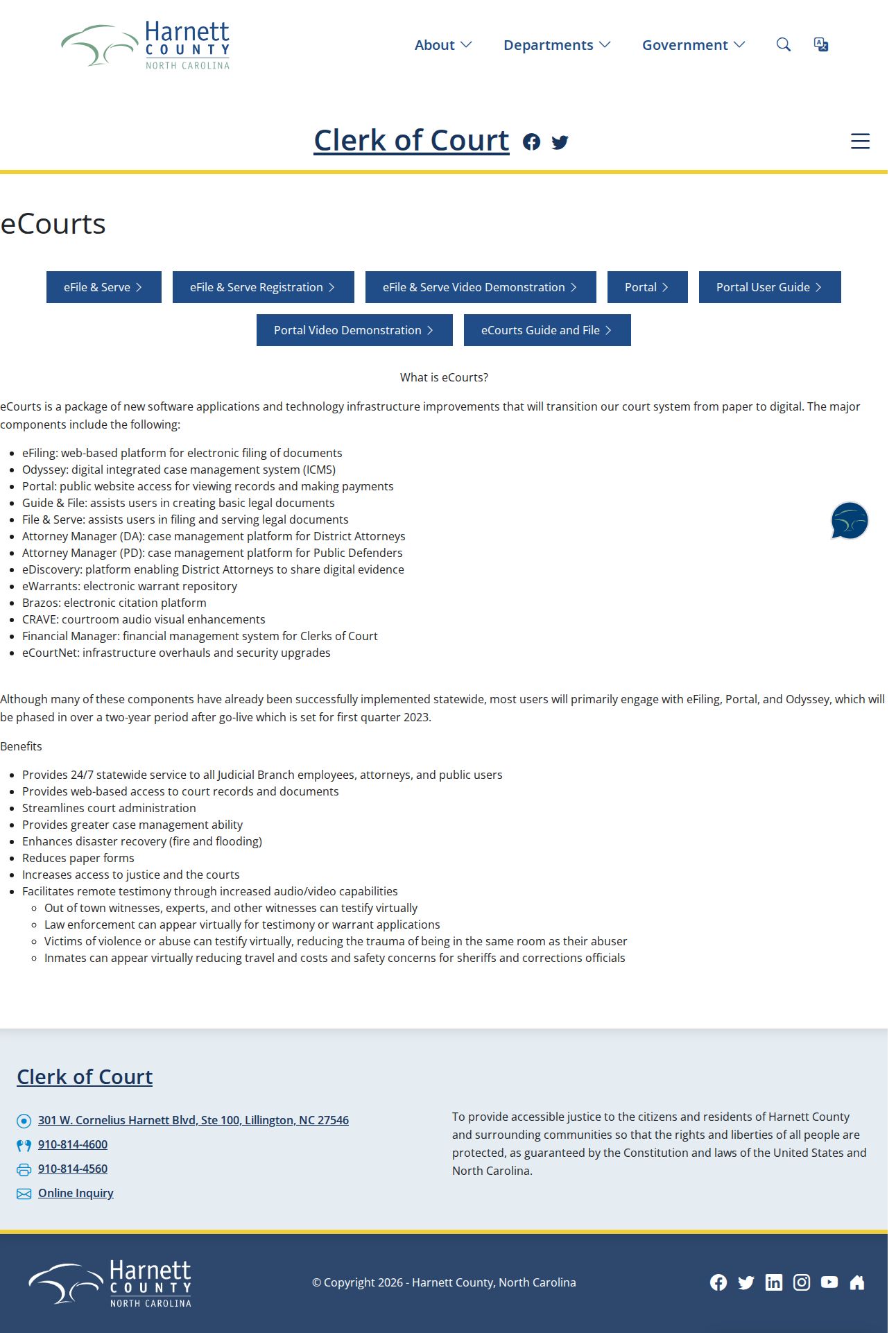
The captured guide helps distinguish public case lookup from filing and document-sharing services, which prevents a reader from opening the wrong tool for a basic docket search.
Inside a Harnett County Case File
A Harnett County criminal case file joins the charging record to the court's activity and result. A calendar entry offers a useful index, but it does not replace the whole file. The official Harnett Superior Court calendar schema includes the session, courtroom, judge, clerk, prosecutor, file number, defendant display, counsel, charge class, bond fields, and blanks for plea, verdict, and judgment. Portal or the paper file must supply attachments and fuller judgment detail.
| Case Number & Court | Identifies the proceeding, division, and Harnett location; newer numbers may follow the YYCR######-420 format. |
|---|---|
| Charging Document | Shows the complaint, warrant, criminal summons, information where allowed, or indictment that brought a count to court. |
| Docket Entries | Chronological events such as filings, settings, motions, continuances, and court actions. |
| Hearing Dates | Lists scheduled events, which should be checked against the current court-date tool or calendar. |
| Disposition & Judgment | States whether a charge ended in conviction, dismissal, acquittal, or another recorded result. |
| Sentence & Conditions | Records the judgment terms entered after a conviction, when publicly available. |
A returned indictment may appear in the case, but grand-jury deliberations remain secret. Sensitive victim information, juvenile matters, and identifiers such as a full date of birth may also be restricted or redacted.
Note: Read the disposition for each charge because one Harnett case can contain counts that end in different ways.
Reading Harnett County Criminal Calendars
Harnett County publishes criminal District Court schedules along with separate DWI, probation cause or violation, Veterans Treatment Court, and holiday calendars. A calendar proves that a matter was set for a session. It does not prove the hearing occurred as first listed or that the displayed charge became the final judgment. Check the live court-date channel and then read the docket outcome.
- Disposition
- The result of one charge, such as conviction, dismissal, or acquittal.
- Arraignment
- A court appearance at which charges are stated and a plea may be entered.
- Indictment
- A grand jury's true bill formally charging a felony or another indictable offense.
- Continuance
- A move of a scheduled matter to a later date; the calendar schema includes a continuance count.
- Judgment
- The court's formal decision and, after conviction, the sentence or other ordered terms.
The county court hub links current schedules. Harnett's named Veterans Treatment Court is based at the courthouse, and its dates are listed apart from the ordinary criminal calendar.
How a Criminal Case Moves
A Harnett criminal case can begin with an arrest, citation, summons, or other process. A magistrate handles the initial appearance or release conditions when required. Misdemeanors remain on the District Court track, while a felony generally starts there before a prosecutor's review and grand-jury indictment move it to Superior Court. Plea talks, motions, or a trial can change which counts reach judgment.
Case flow: Charges Filed › Arraignment › Pretrial › Plea or Trial › Disposition › Sentencing
Follow each count, not just the case caption. One count may be dismissed while another produces a conviction. A pending event is not an outcome, and an arrest charge is not necessarily the charge that the District Attorney prosecutes.
Certified Harnett County Court Searches
A free courthouse-terminal search and a certified clerk inquiry are different Harnett County court record products. Public terminals at North Carolina courthouses can search selected counties or statewide records and can display or email results without a fee. A certified Harnett-only name inquiry costs $25 and uses form AOC-CR-314. It excludes other North Carolina counties, federal cases, out-of-state matters, and sealed or expunged records.
For mail service, the Harnett clerk's certified name-inquiry instructions call for the person's first and last name, middle name or initial if known, date of birth and address if known, a request for a certified name inquiry check, payment by certified check or money order, and a self-addressed stamped envelope. In person, start at the first-floor Cashier. Common names return all matches, so compare available identity fields with care.
Harnett Clerk Criminal Desk
301 W. Cornelius Harnett Blvd., Suite 100
Lillington, NC 27546
910-814-4588
Weekdays, 8:30 a.m. to 5 p.m.; local clerk materials note a 12:30 to 1:30 p.m. counter lunch closure.
Missing Harnett County Case Documents
If Portal identifies a Harnett County case but does not display the needed pleading or judgment, take the file number to the clerk's public terminal or criminal desk. Older paper files can require staff retrieval. An official 2013 Harnett notice reported that pre-2006 District Criminal Court files had been destroyed except for material preserved on microfilm, so ask whether a microfilm image or computer printout remains.
The courthouse also has an eCourts kiosk, and county materials describe an ADA-compliant kiosk outside the magistrate office at 175 Bain Street with round-the-clock access. It can search case events and dates, scan or print, file eligible documents, and make payments. Those tools improve access beyond counter hours, but the clerk still controls archival retrieval and certification.
Note: Call the criminal desk before traveling when an old Harnett County court file may require archive or microfilm retrieval.
Case Record Access & Restrictions
North Carolina G.S. 7A-109 directs clerks to keep court proceeding records and allow inspection subject to law and court rules. Open access does not make every record field public. Juvenile matters, expunged cases, sealed material, confidential witness or victim details, and sensitive identifiers may be withheld or redacted. A public Portal view may also show less than the courthouse file.
Ask the custodian for the precise record. The clerk supplies pleadings, dispositions, judgments, certified inquiries, and archived court material. An arresting police agency supplies its incident or arrest report. The sheriff supplies Harnett County booking and jail records. For the broader distinction between an intake charge and the later case result, use the county's arrest lookup alongside the clerk docket.
North Carolina Public Records Law treats criminal investigative files differently from court files. Body-camera recordings also follow a special disclosure and court-release process. Keep the request narrow and direct it to the office that created the item.