
Sex Offender Checks in Harnett County
The official starting point is the North Carolina Sex Offender and Public Protection Registry. The North Carolina State Bureau of Investigation publishes the site with information entered and checked by sheriffs in all 100 counties. For Harnett County, the Sheriff's Office registers residents, takes the required photo and fingerprints, and sends the record into the state system. The public does not need to find a separate county database.
Use a name search when the person is known. Use county, city, ZIP, address, or proximity tools when the goal is neighborhood awareness. These routes answer different questions. A location search may reveal records that a misspelled name misses, while a name search can find a registrant whose address is outside the first map view. Search results can change as people move or sheriffs verify data.
The registry is narrower than a court or criminal-history search. It includes people who must register under North Carolina law, not every person with any criminal case or sexual-offense history. Juvenile adjudications do not appear in the public registry. An empty result is therefore not a finding that no other record exists. Broader county record channels are outlined in the Harnett County criminal history overview.
Harnett County Registry Use Gate
Before the search form opens, the NCSBI registry presents an acceptable-use screen. Its focus is public protection, information, and proactive community safety. That gate is part of the official search flow, not a routine pop-up to dismiss without reading. It explains why a listing may change and why the site cannot guarantee that all data is current at the instant it is viewed.
The official registry use policy can be reviewed before beginning a Harnett County sex offender search. The captured screen below preserves the state wording and shows the entry point used by the public.
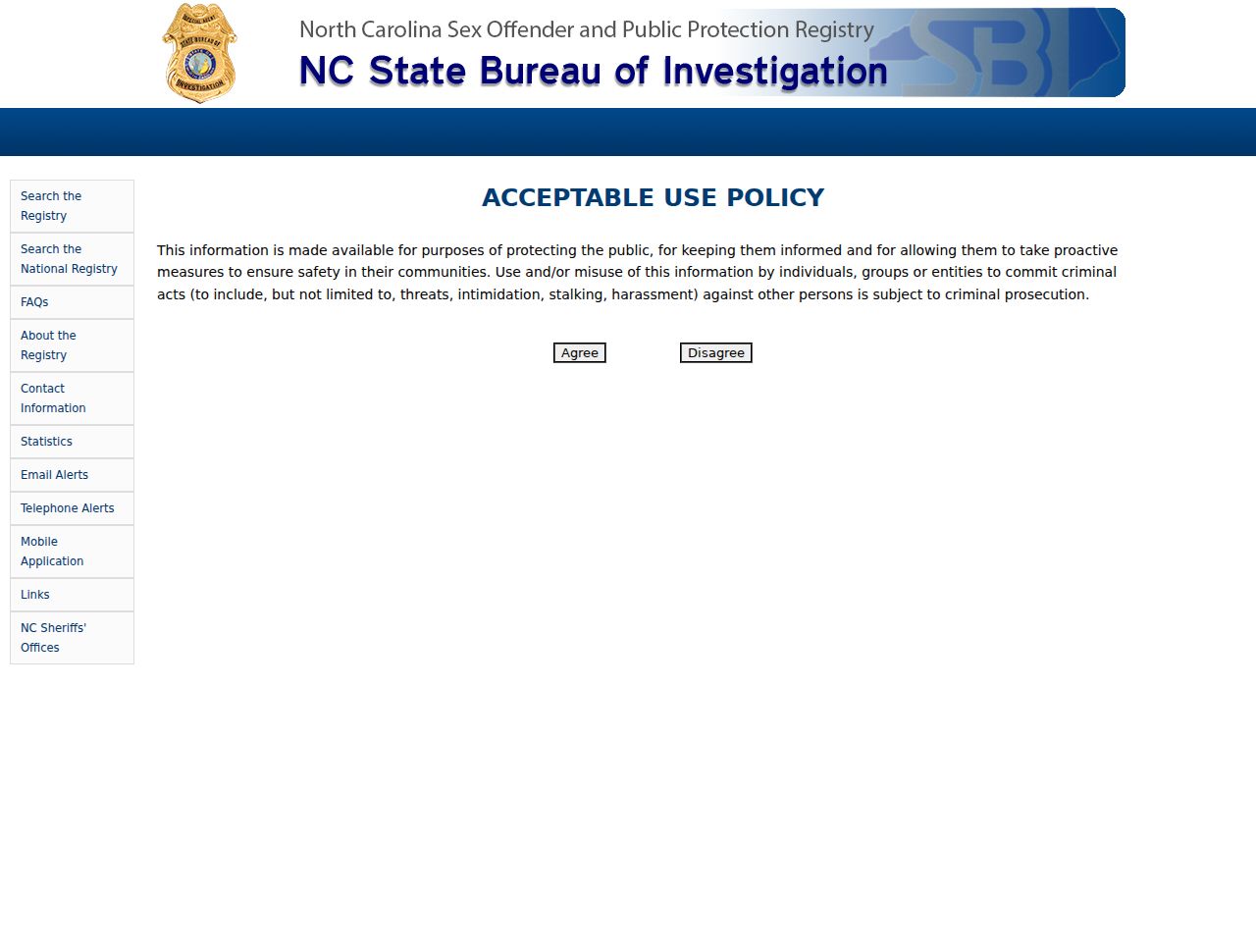
This gate frames every later result as a safety resource with legal limits, rather than proof of identity based on a name alone.
How to Search the North Carolina Sex Offender and Public Protection Registry
The registry offers more than one path into Harnett County records. Gather a full name, possible aliases, city or ZIP, and an approximate age before searching. If the concern is tied to a home, school route, or other place, begin with the address or proximity option. If the subject is known, start with the name but plan to compare the result with the photo, date of birth or age, physical details, registration number, and offense data.
- Open the NCSBI registry and read the acceptable-use terms before entering the search.
- Choose an offender-name route or a location route, then add Harnett County, city, ZIP, or street details when available.
- Review both list and map results. Do not assume that a common or partial name identifies the right person.
- Open the full profile and compare several identifiers. Use the sheriff contact when an address or status appears wrong.
The NCSBI registry search form shows the controls used for offender and location checks. The image records the official interface rather than a commercial copy of registry data.
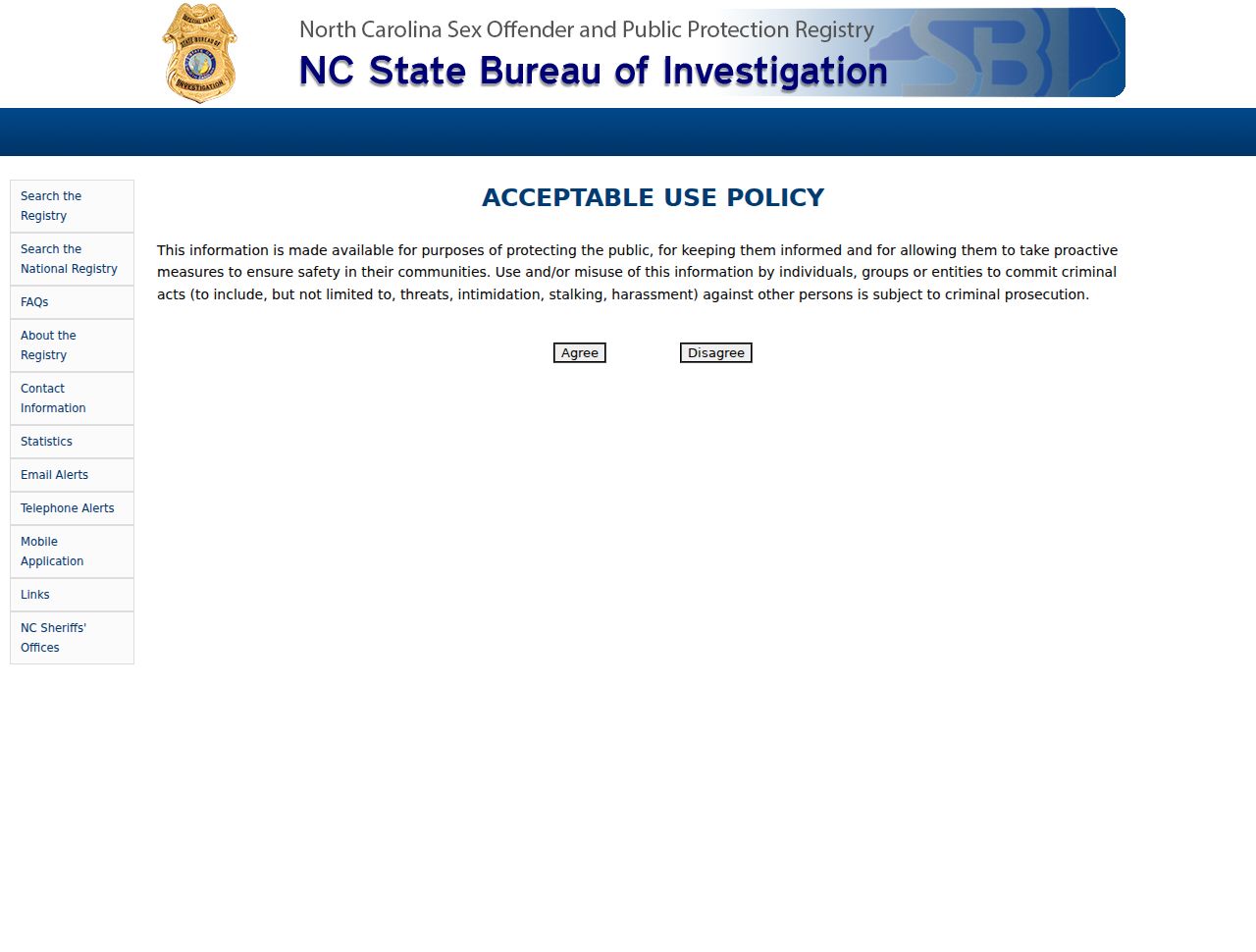
Those controls make it possible to narrow a broad North Carolina search to Harnett County without treating any single field as conclusive.
| Field | Control | Required | Use |
|---|---|---|---|
| Last Name | Text | Route dependent | Accepts a known or partial surname |
| First / Middle Name | Text | No | Narrows common-name results |
| County | Dropdown | No | Select Harnett for county results |
| City / ZIP | Text or choice | No | Narrows by registered place |
| Address / Proximity | Location fields | Route dependent | Searches around a supplied place |
| Registration Number | Text | Alternative | Uses an exact registry identifier |
Reading Harnett County Registry Totals
The state statistics page displayed about 302 Harnett County entries when the research was inspected. That figure is a dated snapshot, not a fixed county population. NCSBI warns that totals are approximate, can reflect delays or data errors, and omit some pending statuses. A total also counts public registry entries, which is not the same measure as convictions, current residents, or people physically present on a given day.
The official registry statistics page supplies the county view and its cautions. The screenshot shows why the source date and the state's notes should travel with any quoted Harnett County number.
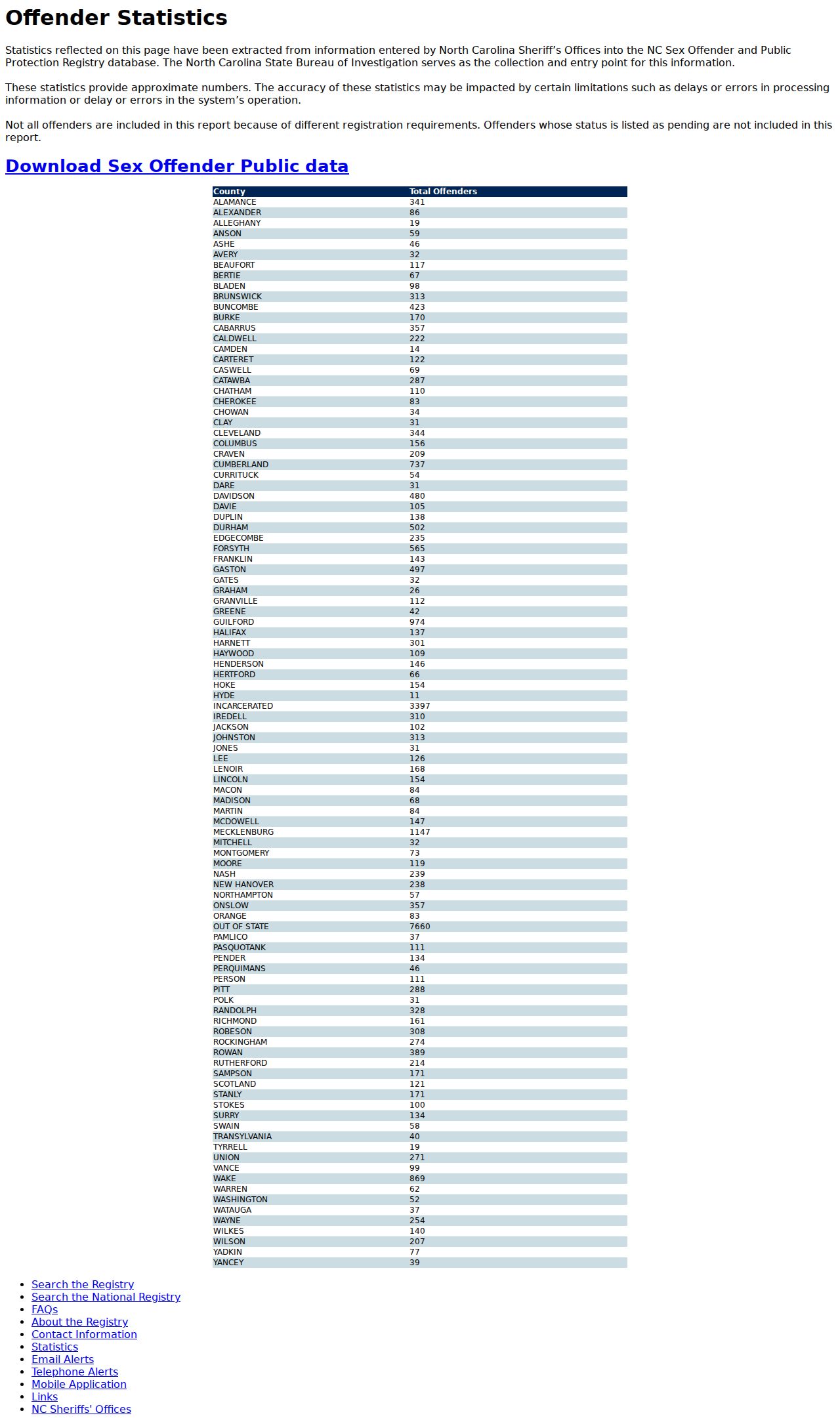
The useful takeaway is scale, not a permanent total. Run a fresh registry search when the current status of a person or address matters.
Inside a Registry Profile
A public profile combines identifiers, registration facts, and offense information. It may show a current photo, aliases, physical traits, address, registration county and status, conviction details, verification dates, and a mapped location. Some items collected by the sheriff, such as online identifiers or vehicle details, appear where the statute and registry presentation make them public. Victim details are not part of the public profile.
Read the record as a whole. The SBI cautions that only fingerprint comparison provides positive identification. A similar name, face, or street is not enough. Address and school details may be self-reported and can change between verification events, so a suspected error belongs with the Harnett County Sheriff's Office.
| Name and Aliases | Current name, other reported names, and the name used at conviction where shown. |
|---|---|
| Photo and Description | Current sheriff photo plus age or birth data, sex, race, height, weight, hair, eyes, and visible marks where published. |
| Registered Address | Reported residence and map location, subject to update and verification timing. |
| Offense Record | Reportable offense, conviction date, sentence, and related classification details. |
| Registry Status | Registration number, county, current status, and verification information. |
| Other Public Fields | Institution, vehicle, or online identifier details when collected and lawfully displayed. |
Note: A profile match should be checked against several fields, and only fingerprints can establish identity with certainty.
Harnett County Offender Registration
Registration happens in person with the county sheriff. In Harnett County, the registration point is the Harnett County Sheriff's Office at 175 Bain Street in Lillington. The office can be reached at 910-893-9111. Under G.S. 14-208.7, a person subject to the law must register within three business days after release or arrival, or immediately after a qualifying conviction when there is no active term of imprisonment.
The sheriff takes the registration photo and fingerprints without charge and records the statutory identity, address, conviction, school, institution, and online-identifier fields. The original remains with the sheriff, while the information is sent at once to the state system. That local-to-state path explains why corrections should go to HCSO rather than through public confrontation or edits on a third-party site.
Harnett County Sheriff's Office
Sex offender registration
175 Bain Street
Lillington, NC 27546
910-893-9111
Confirm current registration instructions before visiting.
North Carolina Registration Levels and Requirements
North Carolina does not assign one simple public Tier I, II, or III label to every registry profile. Its law uses program and classification categories. A general Part 2 registrant has a baseline term of at least 30 years and may petition Superior Court after 10 years under the governing statute. Aggravated offenders, recidivists, and people classified as sexually violent predators fall under lifetime Part 3 registration.
Satellite-based monitoring is a separate statutory and court analysis. It should not be treated as an automatic public tier. The key is to read the actual classification and status on the record, then consult the current law for the duties tied to that classification.
| Program or Classification | Duration / Review | Public Meaning |
|---|---|---|
| Part 2 general registrant | At least 30 years; petition may be available after 10 years | County registration with periodic address checks |
| Aggravated offender | Lifetime | Part 3 category based on the statutory offense definition |
| Recidivist | Lifetime | Part 3 category tied to a prior reportable conviction |
| Sexually violent predator | Lifetime | Part 3 status reached through the applicable court or board process |
| Satellite-based monitoring | Separate analysis | Not a substitute for the registry classification |
Harnett County Alerts and NSOPW
The North Carolina registry offers email alerts tied to neighborhood or location changes. That option is useful for ongoing Harnett County awareness because it does not require a resident to repeat the same map check each day. Alerts still depend on the data reported and verified through the sheriff, so they do not replace checking the live profile when a specific question arises.
For a search that crosses state lines, use the U.S. Department of Justice National Sex Offender Public Website. NSOPW searches participating jurisdictions in one place, while the NCSBI registry remains the more direct source for North Carolina fields, county filters, and local alert tools. The two routes complement each other. Neither is a general criminal-record search.
Correcting Harnett County Registry Data
If a Harnett County address or compliance status looks wrong, record the registration number and the precise field in question. Do not approach the listed person or household. Call HCSO at 910-893-9111 and give detailed information that the registration staff can compare with its file. The sheriff is the local verifier and the proper first point for a possible noncompliance report.
The NCSBI registry FAQ explains data limits, public notification, reporting, juvenile exclusions, and misuse. Its official screen is reproduced below so readers can see the state's own answers behind the Harnett County search process.
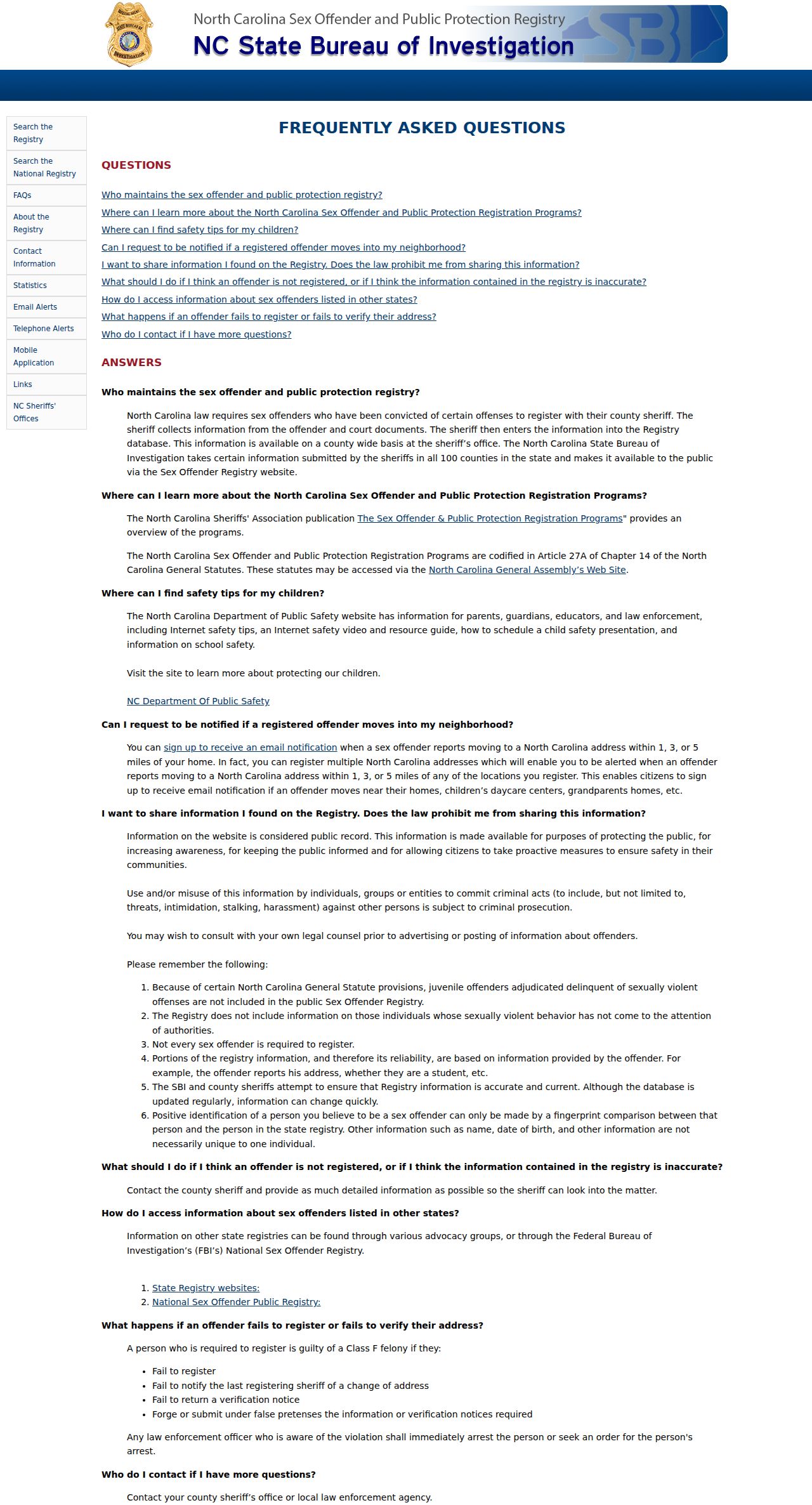
The state guidance reinforces a simple rule: send corrections to law enforcement, and never try to resolve a suspected mismatch face to face.
Community Notification and Lawful Use
Registry information supports personal, family, and neighborhood safety. It can inform a route check, a move alert, or a discussion about safe boundaries. It does not authorize threats or informal enforcement. Harnett County residents should use official profiles, keep the limits of self-reported and changing data in view, and notify the sheriff when facts appear stale.
G.S. 14-208.10 defines the public registry framework. The NCSBI use policy warns that threats, intimidation, stalking, harassment, and other criminal misuse may be prosecuted. Public access and lawful conduct operate together.
Use registry records lawfully: Misusing North Carolina registry information to threaten, intimidate, stalk, or harass a registrant or household can be prosecuted.
Registry absence also has a firm limit. It means only that the search did not return a matching public registration. It does not establish that a person has no other court case, nonpublic juvenile matter, out-of-state record, or offense that did not require registration.